
Creator tax guide: What to know when you turn passion into a paycheck
As a creator, you’re not just creating content—you’re following your passions, building a community and a successful life on your terms.
And when your content leads to making money, taxes can get complicated. You need a trusted tax provider that gets you and the many ways you earn.
Because at the end of the day, your taxes are as unique as your content and H&R Block is here to make the complex easy, so you can get a handle on your taxes and focus on creating.
Explore the Creator tax guide below.
Review Creator taxes FAQs.

Resource guide overview
Tax basics breakdown
If taxes feel like a big unknown, we got you. Find out what you must do for your creator taxes—and what not to do.
Explore
Growing your footprint
As your content activities expand, we’ll help you make sure you’ve got your tax and financial bases covered.
Leveling up your biz
Build out your team, understand the benefits of incorporation and go deep into the numbers. Get ready for the next step.
Earn like a creator, file like a pro
From reporting ad revenue to deducting editing software, Block is here to make the complex easy so you can get a handle on your creator taxes.
File your creator taxes DIY with tax prep designed specifically for creators.
See a demo video of the tool.

Tax basics breakdown
Here’s the thing: Whether you pull in $1,000 or $100,000 as a creator, the IRS still needs to know about it. How much could you owe? That depends on your total income, deductions, and other details.
And because the IRS sees you as self-employed, it’s important to get a handle on concepts like self-employment (FICA) taxes and paying taxes throughout the year.
Lastly, check out the forms to know. It’s not the fun part, but they’re totally necessary.
Tax forms to know
Form W-9 to certify your Social Security number (SSN) with partners.
Form 1099-NEC to report your nonemployee compensation.
Form 1099-K to report third party payments.
What can I write off as a creator?
Being a creator means you’re your own boss—and that comes with tax perks.
- One big IRS rule: Write-offs must be “ordinary and necessary” for your work.
- Think editing tools, lighting gear, and sound equipment—these are usually safe bets.
- The gray areas? Travel, clothing, and meals—those need extra care to get right.
Dive deep into creator write-offs and find tax tips for fashion and make-up influencers, food bloggers, and gamer content creators.

Growing your footprint
As your content endeavors grow, so do your tax considerations. The IRS isn’t checking your follower count, but there are things they look for as you ramp up into a business.
The right know-how and tools can help make getting a handle on your finances easier.
Whether it’s navigating earning income in multiple states (yep, those out-of-state gigs have tax implications) or combining deductions for large equipment purchases, we’re here for you.
Quarterly taxes for creators
Creators must make quarterly payments to stay on top of taxes and avoid IRS penalties.
You have two options:
- The simple “safe harbor method” or
- Crunching the numbers for more accurate payments.
- The gray areas? Travel, clothing, and meals—those need extra care to get right.
Get the scoop on quarterly taxes and check out our Creator tax cheat sheet and checklist.

Leveling up your biz
Your business is leveling up (congrats!). That means plenty of financial and tax questions.
Where could you use help and what are the implications of hiring? How can you save money on taxes and protect what you’ve built?
We’re here to help you make smart moves and take tax, bookkeeping and payroll tasks off your shoulders so you can focus on your passions.
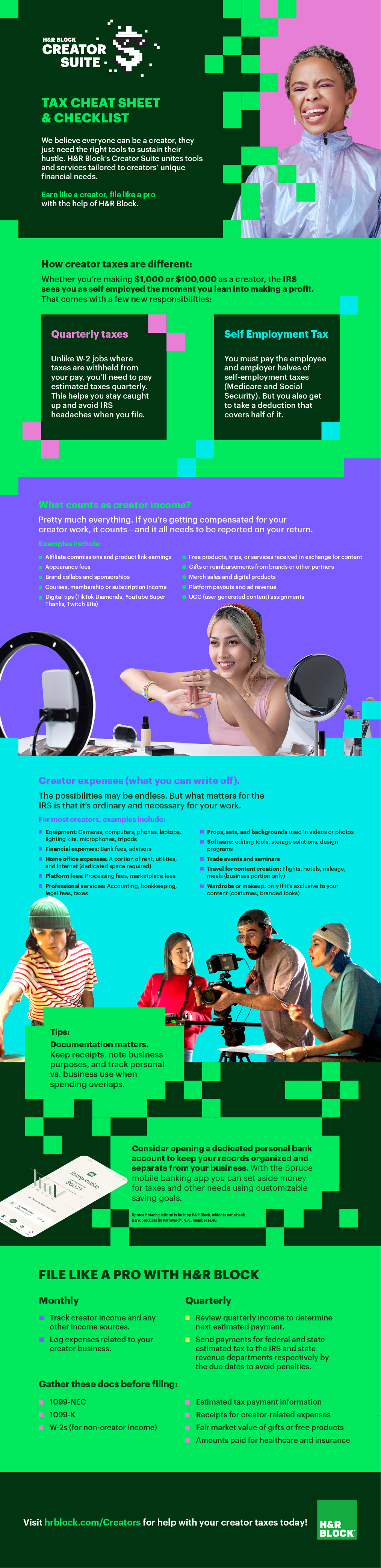
Creator tax cheat sheet and checklist
Get creator tax tips and a simple checklist —stay organized and maximize your deductions.
Creator taxes FAQs
Get answers to your burning questions about content creator taxes, expense deductions, and more.
Co content creators pay taxes?
Absolutely. Whether you’re streaming, blogging, or posting hauls, income from your content counts. As part of your tax to-dos, you’ll need to pay self-employment tax and make quarterly estimated payments.
Do creators pay taxes on gifts or brand deals?
Content creators must pay taxes on all income from brand deals, including cash and the fair market value of gifted products received in exchange for a service. This includes:
- Cash Payments: Income from sponsored posts and brand partnerships.
- Gifted Products/Services: The fair market value of free products, travel, or services received in exchange for a post or review is taxable. If no service is expected, it may not be taxable, but most business-related gifts fall under the taxable category.
- Affiliate Commissions: Earnings from affiliate marketing links.
- Ad Revenue: Income from platforms like YouTube or TikTok.
- Donations and Tips: Contributions from followers on platforms like Patreon or Ko-Fi.
What are some tax write-offs for creators?
Common write-offs align with the tools of the trade: cameras, lighting, editing software, and . If it’s “ordinary and necessary” for creating content, it could be deductible. You may even be able to deduct part of your home office as long as you use it regularly and exclusively for your work. Check out our creator tax deductions article for details.
Can you write off the products you review?
If you bought the product solely for creating content, yes—it’s a business expense. But if you also use it personally, you’ll need to split the cost between business and personal use. Check out our creator tax deductions article for details.
File yourself with tools for creators
On-the-go DIY tax prep for multi-income, multi-platform earners.
- Help claiming every credit and deduction for your business.
- Online support from live tax pros and AI Tax Assist.
File with an H&R Block tax pro online
Creator-savvy support from a tax pro any time, on any device.
- Let a pro handle it all in as little as one hour.
- Choose your pro or get matched based on your needs.